CoRL 2026 · Paper 1930
Robot-DIFT
Correspondence-Sensitive Diffusion Features
for Contact-Rich Robot Manipulation
1 TU Darmstadt2 KIT3 FZI4 Hessian.AI5 Robotics Institute Germany6 Honda Research Institute Europe GmbH
* Equal contribution






Precise control requires visual features that preserve small, action-relevant changes.
Robot-DIFT adapts diffusion correspondence features to robot data and exposes their spatial detail through a multi-scale readout.
2:30 research overview and robot demonstrations · Silent video
Why local correspondence matters
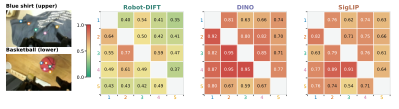
A policy can recognize the correct object yet miss the final alignment. A pin just left or right of a hole requires opposite corrections.
We call the required property correspondence sensitivity: nearby object configurations that require different actions should produce local, discriminative feature changes.
How can diffusion correspondence features become a reusable representation for precise robot control?
Robot-DIFT overview
01 / Backbone pretraining
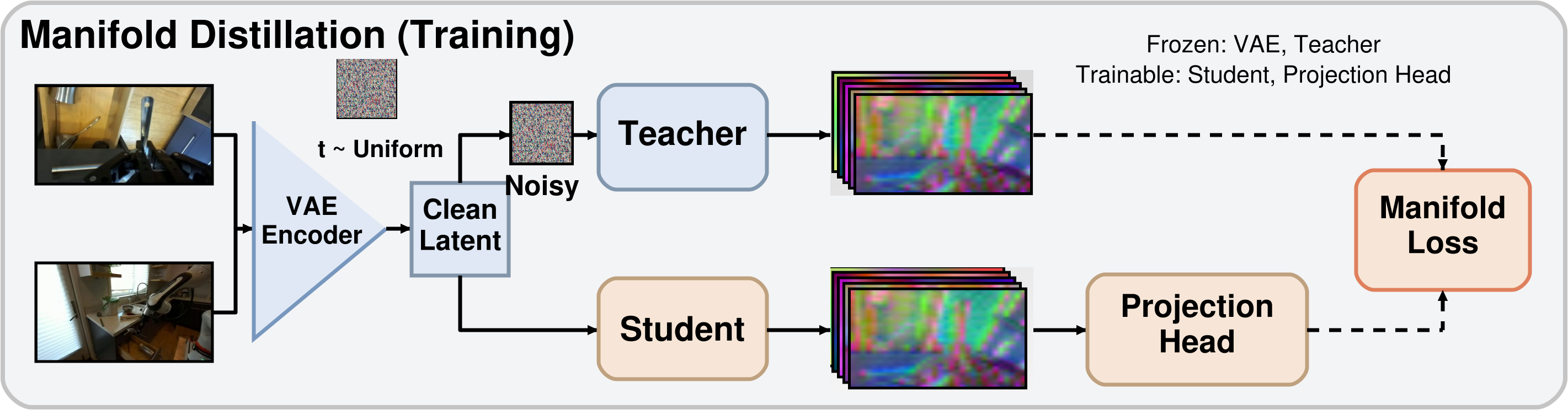
DROID pretraining with Manifold Distillation
Imitation learning adapts the Student to robot observations and actions. Annealed feature alignment to a frozen diffusion Teacher helps retain the pretrained spatial features.
02 / Policy-facing features
S2-FPN combines coarse semantics and fine spatial detail
A Spatial–Semantic Feature Pyramid Network fuses three Student decoder scales before policy pooling. Downstream tasks reuse the frozen Student and train a new readout and policy.

Evidence across two manipulation benchmarks
RoboCasa compares visual representations under a shared policy setup. LIBERO-10 evaluates language-conditioned transfer with a frozen Student.
RoboCasa
| Method | Success ↑ |
|---|---|
| CLIP | 19 |
| SigLIP | 27 |
| VGGT | 22 |
| FastVGGT | 23 |
| DINOv2 | 28 |
| DINOv3 | 33 |
| SiT | 29 |
| DIFT | 38 |
| Robot-DINO | 40 |
| Robot-DIFT | 48 ± 1 |
LIBERO-10
| Method | Success ↑ |
|---|---|
| DP-C | 53 |
| DP-T | 58 |
| OpenVLA | 54 |
| π0 | 85 |
| π0-FAST | 60 |
| UniPi | 0 |
| UVA | 90 |
| DIFT-VLA | 68 |
| Robot-DIFT | 92 ± 1 |
Robot-DIFT: three-seed mean ± standard deviation; baselines: one seed. 50 rollouts per task. Baseline sets differ across the two benchmarks. Values follow Tables 1 and 3(a) and the accompanying text in the paper.
Both the backbone and the readout matter. Controlled backbone/readout experiments show that S2-FPN improves policy performance, while diffusion-derived features retain an advantage under the same readout. The full paper includes these controls, correspondence tests and real-robot validation.
Abstract
Robot manipulation often fails in the final millimeters: a policy may recognize the right object yet miss the pose offsets, boundaries, or pre-contact alignments needed for action. We argue that such failures arise when semantic invariance suppresses correspondence cues for closed-loop control, or when these cues are not exposed to the policy in a usable form. Modern visual encoders provide strong semantic abstractions, but contact-rich manipulation requires correspondence sensitivity: discriminative feature responses to action-relevant changes in pose, boundary, and contact geometry. Diffusion features provide a strong prior for dense correspondence, but direct use is impractical due to stochasticity, latency, and representation drift. We introduce Robot-DIFT, a deterministic diffusion-derived backbone for real-time control. Through Manifold Distillation, Robot-DIFT converts a noise-conditioned diffusion Teacher into a clean-input, single-pass Student while preserving the teacher’s feature manifold. A Spatial–Semantic Feature Pyramid Network (S2-FPN) fuses coarse-to-fine Student decoder features into visual tokens that expose semantic context and fine contact detail to the policy. Across RoboCasa, LIBERO-10, and real robots, Robot-DIFT outperforms vision–language, self-supervised, geometry-oriented, and diffusion baselines on contact-sensitive tasks. Controlled backbone/readout swaps show that S2-FPN unlocks, rather than replaces, the diffusion correspondence prior.
BibTeX
@inproceedings{deng2026robotdift,
  title = {Robot-DIFT: Correspondence-Sensitive Diffusion Features
           for Contact-Rich Robot Manipulation},
  author = {Deng, Yu and Jin, Yufeng and Jia, Xiaogang and Xue, Jiahong
            and Neumann, Gerhard and Chalvatzaki, Georgia},
  booktitle = {Conference on Robot Learning (CoRL)},
  year = {2026},
  url = {https://arxiv.org/abs/2602.11934}
}